

What it does
A Custom Web Agent column runs a natural-language prompt against the open web for every row in your Bridge, then returns the result as a structured column. It’s the counterpart to Custom AI Analysis: AI Analysis reasons over data you already have in Starbridge, while a Web Agent column goes out and finds new data — a district’s website, a budget document, a local news article — and brings it back into your Bridge.Example use cases
- Grants & funding. Has this district received any technology grants in the last 3 months?
- Budget & procurement. What’s this buyer’s technology budget, or the dollar threshold that triggers a formal RFP?
- Org-specific detail. How many distance/virtual learners are enrolled? How large is this fire department’s fleet?
- Anything else public but hard to find. If it’s findable with a web search and you can describe it in a prompt, a Web Agent column can go get it — for every row in your Bridge, at once.
Set up a Custom Web Agent column
From any Bridge, click “Add enrichment”, choose Custom Web Agent, name the column, then configure it.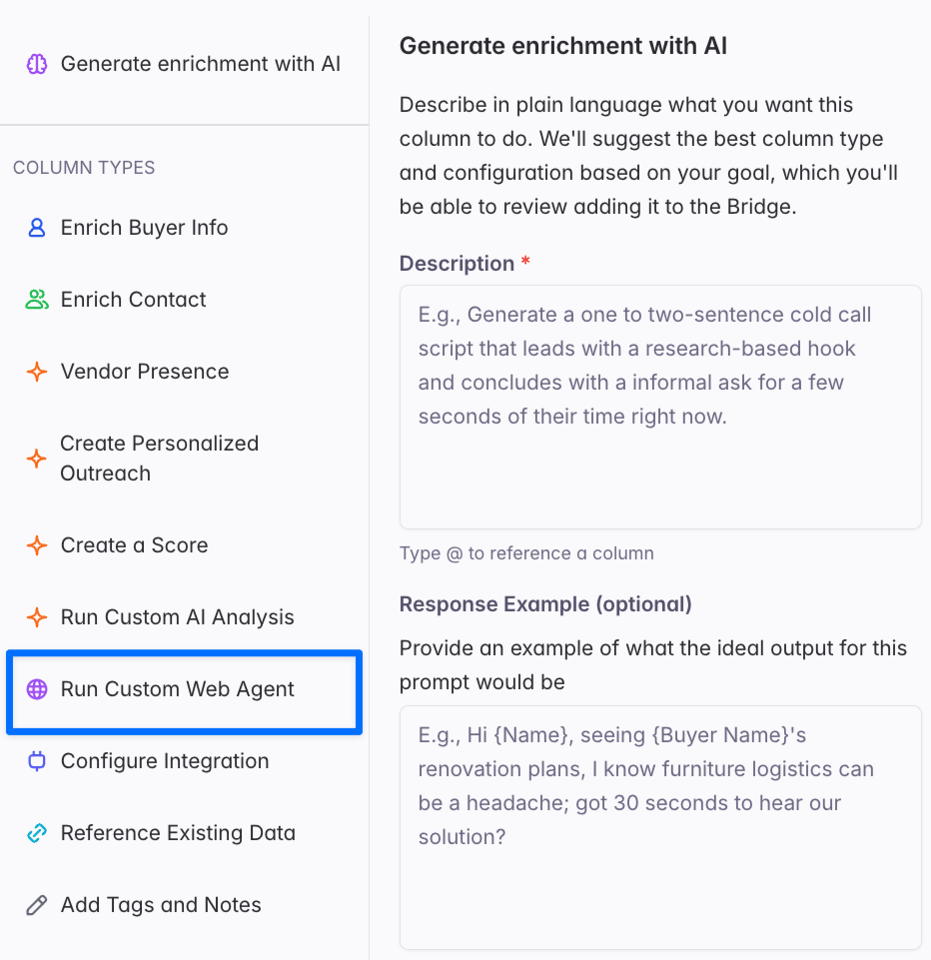
1
Write your prompt
Describe what to search for in plain language. Reference buyer attributes with @ so the agent knows who and what to search — for example,
@Buyer Name or @Enrollment Trend — and be specific about the output format you want back.2
Choose a model tier
Pick Core, Pro, or Ultra depending on how deep the search needs to go. Higher tiers search more thoroughly and cost more credits per run — see Credits below.
3
Set your output fields
Choose Single Output for one value per row, or Multiple Output to split the result into several fields. Pick a Field Format (text, number, date) so the column is typed correctly for sorting, filtering, and CRM sync.
4
Set Run Conditions and Rerun Settings (optional)
- Run Conditions control when the enrichment runs. Without one, it always runs.
- Rerun Settings control how often the column refreshes. Without a rule, it won’t re-run automatically — useful to set for anything time-sensitive, like grants or leadership changes.
5
Add & run the enrichment
Click “Add Enrichment” to run it. Test on the first few rows first: prompting is iterative, so check the output, refine, and rerun before running every row.
Credits
Unlike Custom AI Analysis, Custom Web Agent columns consume credits, since each run searches the live web. Cost depends on the model tier you choose:
A column that reruns on a cadence consumes credits on every run, not just the first. See How do credits work? for the full breakdown and worked examples.
Not the same as a Custom Web Signals Bridge. A Web Agent column is a single enrichment you add to any existing Bridge (Meetings, RFP, Buyers, Contacts, etc.) to pull in web data per row. A Custom Web Signals Bridge is a whole Bridge type that searches the web for a signal you define, across your entire buyer list, on its own recurring cadence.
Example prompts
Active technology grants (past 3 months)
Active technology grants (past 3 months)
Medicaid caseload volume (latest verified year)
Medicaid caseload volume (latest verified year)
Related articles
Custom AI Analysis
Analyze data already in your Bridge — no web search, no credits.
Custom Web Signals Bridge
Search the web for a signal across your entire buyer list, on a recurring cadence.
How do credits work?
How credits are metered across Web Agent columns, contacts, and Custom Web Signals Bridges.
Enriching Bridges with data
An overview of every column type you can add to a Bridge.